

| Culture | Branch | Tradition | Ware | Type |
| Ancestral Pueblo: Southern Colorado Plateau (Anasazi) | Central Anasazi | Southern Cibola | Acoma Historic Matte Paint Ware | Acoma (McCartys) Polychrome |
Type Name: Acoma (McCartys) Polychrome |
|
| Period: | 1890 A.D. - 0 Now |
| Culture: | Ancestral Pueblo: Southern Colorado Plateau (Anasazi) |
| Branch: | Central Anasazi |
| Tradition: | Southern Cibola |
| Ware: | Acoma Historic Matte Paint Ware |
First posted by C. Dean Wilson 2014
Among the earliest descriptions and discussions of the pottery that was being produced at Acoma by the late nineteenth and early twentieth was by Bunzel (1929). Chapman (1936) also described Acoma Polychromes vessels from various collections. Acoma Polychrome is defined by changes in pottery produced at Acoma Pueblo during the late 19th century resulting in characteristics that still persist in pottery produced at this Pueblo (Frank and Harlow 1990; Harlow 1973; Lammon and Harlow 2013). Acoma Polychrome represent among the most attractive and well-made of any Pueblo pottery still produced. Changes noted for this type are based on trends noted for whole vessels collected from Acoma and surrounding Pueblos during the late nineteenth and early twentieth century so that sherd-based distinctions may be quite difficult and may be largely based on nuances in vessel form.
The transition from Acomita Polychrome to Acoma Polychrome appears to have been gradual, and Chapman (1973) placed intermediate forms into what he describes as McCartys Polychrome. The line design is usually simple consisting of diamonds, split leaves, and rectangular areas. while the body rarely exhibit the complex figures typical 20th century Acoma Polychrome. It is probably best to group Acoma Polychrome and McCarty Polychrome together, particularly during sherd-based analysis.
Pastes exhibit fine textures and are light gray to white with a hardened taffy look (Harlow 1973). Temper consists of light-colored crushed potsherd. Temper usually contains orange material and few black grains with sand grains being rare. The white slip covering much of the surface tends to flake off in examples produced during some periods and may reflect depletion of certain sources.
Together, the distinct combination of temper, pastes, and slips utilized in Acoma Polychrome distinguish it from similar mineral painted types produced in the Middle Rio Grande, Laguna, and Zuni areas. Contemporary decorated forms produced by potters in the Northern Tewa and Eastern Keres regions are distinguished by several criteria including decorations in organic pigment.
The lower slopes of the neck ten to straightening during the late 19th century. Vessels are well-formed and consistently finished. Curves in the shoulders of jars became sharper. Acoma Polychrome includes examples decorated with both black paint alone and combinations of black and red paint. Designs are characterized by combinations of interconnecting elements. The lowest framing lines were pushed closer to the base of the vessel. The two-band design gave way to all-over patterns that included complex and well executed patterns incorporating solid and hachured design elements as well as plant, bird, and animal figures.
References:
Bunzel, Ruth
1929 The Pueblo Pottery. Columbia University Contributions to Anthropology. No, 3, New York.
Chapman, Kenneth
1938 The Pueblo Indian Pottery of the Post Spanish Period. General Series Bulletin No. 4, Laboratory of Anthropology of Anthropology, Santa Fe.
Frank, Larry and Francis H. Harlow
1990 Historic Pottery of the Pueblo Indians 1600-1880. Schiffer Publishing, Ltd., West Chester Pennsylvania.
Harlow, Francis H.
1973 Matte Paint Pottery of the Tewa, Keres, and Zuni Pueblos. Museum of New Mexico, Santa Fe.
Lammon, Dwight P. and Francis H. Harlow
2013 The Pottery of Acoma Pueblo. Museum of New Mexico Press, Santa Fe.
Related Photos
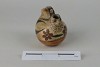
Acoma Polychrome effigy
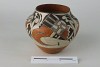
Acoma Polychrome jar
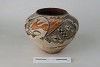
Acoma Polychrome jar
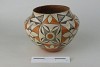
Acoma Polychrome jar
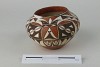
Acoma Polychrome jar
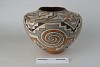
Acoma Polychrome jar
 © New Mexico Office of Archaeological Studies, a division of the New Mexico Department of Cultural Affairs.
The Center for New Mexico Archaeology
7 Old Cochiti Road
Santa Fe, NM 87507
505-476-4404
Fax: 505-476-4448